
Overdose Deaths
A Note About the Recent Dramatic Decline

It has become well known that overdose deaths in the United States have surged in recent years, fueled largely by the influx and prevalence of pure, potent, and plentiful illicit fentanyl, a powerful synthetic opioid that is manufactured, smuggled, and distributed by drug cartels and their crime partners throughout our country.
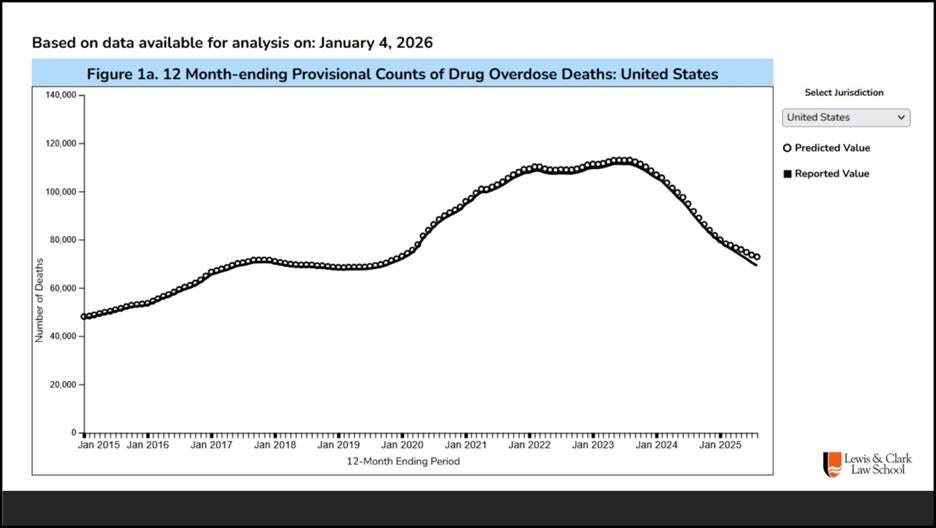
But over the past two years, overdose deaths, which had been killing more than 100,000 Americans each year, plummeted:
There has been much speculation about the reason for that sudden decline. Over the past year or so, I’ve posted multiple links to some of that speculation on the Drug Law and Policy Links page of this Substack.
But earlier this month – on January 8 – a peer-reviewed study was published in the journal Science. The study knocked out much of the speculation, such as the notion that the dramatic drop in overdose deaths is due to expanded access to naloxone or increased access to treatment. Instead, as a January 14 article published by Psychology Today stated, the conclusions of the study can be summarized as follows:
“International supply-side disruptions reduced drug overdose deaths. By the end of 2024, provisional national data suggested a reduction of more than one-third in annual deaths involving synthetic opioids.
“The sudden fentanyl supply shock was driven by international precursor controls and chemical regulation. Regulatory actions taken by the Chinese government may be the primary driver of this unexpected decline in mortality.
“Whether the decline endures will depend on how quickly illicit manufacturers and governmental authorities adapt. The new Science study provides the strongest empirical evidence to date that synthetic drugs, like fentanyl, are highly supply-chain sensitive.”
As can be expected in the drug policy world, responses to the study have been varied. For example:
On January 20, The Atlantic published an article by Charles Fain Lehman of the Manhattan Institute, concluding that, while the cause may be far outside the control of American policy makers, we now have a golden opportunity to focus on getting a lot of people suffering from severe addiction into treatment and recovery.
On January 22, The Free Press published an article by Sally Satel of the American Enterprise Institute, offering various alternative explanations and concluding that the jury is still out on the ultimate causes.
For my part, I am less skeptical of the conclusions of the study, and believe that American policy makers can and should – as they have repeatedly done in the past – have a significant impact on international supply-side controls for synthetic drugs, which should be an essential element to a comprehensive drug policy for our country based on evidence of what actually works. But, of course, this is just my opinion.
Taking credit for this significant and sustained decline in overdose deaths might be somewhat challenging for partisans in our highly polarized United States of America of 2026. As can be seen from the chart above, the dramatic decline started a year before President Trump took office again, once the Biden Administration realized their Harm Reductionist approach to solving our addiction crisis was a complete failure, and spent some effort on international precursor and border controls. On the other hand, the trajectory of the decline has been sustained over the course of the first year of the second Trump Administration, which has made international precursor and border controls a key element of United States drug policy.
As Charles Fain Lehman noted in his essay for The Atlantic:
“When their supply dries up, some people get off drugs; now is a great time to help them.”
“If we want to lock in the unexpected windfall from the drought, now is the time to focus on getting people clean.”
I couldn’t agree more.